
01Ravenna at a glance
A trip along the coast from Hotel Viking, the Antonioli family's 3-star hotel in Viserbella di Rimini: Ravenna is the city of mosaics, with eight early Christian and Byzantine monuments on the UNESCO World Heritage list, from San Vitale to the Mausoleum of Galla Placidia, plus Dante's Tomb.
It is 47.7 km from the hotel, about 70 minutes by car, and in the evening you are back by the sea for our Romagna cooking. Festivals and events at that time of year are listed on our events in Rimini page.
| Where | Piazza del Popolo, 48121 Ravenna (RA) |
|---|---|
| From the hotel by car | 47.7 km, about 70 minutes |
| By train | Ravenna railway station |
| When to go | all year round, rainy days included |
02History and curiosities
- Since December 1996 eight early Christian and Byzantine monuments in Ravenna have been UNESCO World Heritage Sites for the "supreme artistry of the mosaic art": the Mausoleo di Galla Placidia (Mausoleum of Galla Placidia), the Battistero Neoniano (Neonian Baptistery), the Battistero degli Ariani (Arian Baptistery), Sant'Apollinare Nuovo, the Cappella Arcivescovile (Archiepiscopal Chapel), the Mausoleo di Teodorico (Mausoleum of Theodoric), San Vitale and Sant'Apollinare in Classe.
- Ravenna was a capital three times: of the Western Roman Empire from 402, when Emperor Honorius moved his court here from Milan; then of the kingdom of Theodoric, King of the Goths; and finally of Byzantine Italy, until the Lombard conquest of 751.
- The Basilica of San Vitale was commissioned by Bishop Ecclesius after a journey to Constantinople in 525, financed by Julianus Argentarius and consecrated in 547 by Bishop Maximian. It is the most visited monument in the city.
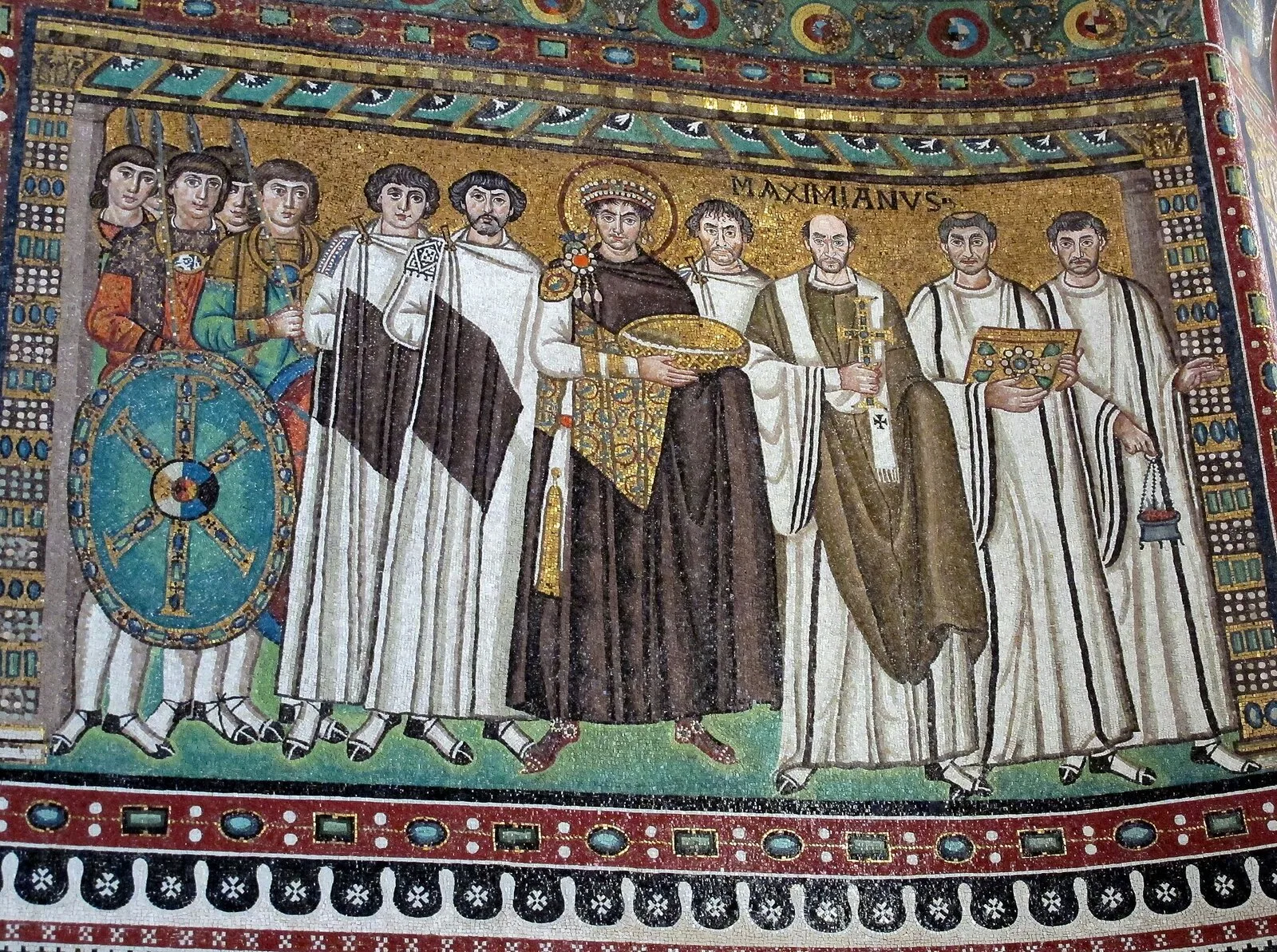
- In the presbytery of San Vitale, Emperor Justinian and Empress Theodora, surrounded by their courts, bring offerings of a paten and a golden chalice; in the apse a young, beardless Christ appears dressed in purple, and at the top of the vault is the Mystic Lamb. Gustav Klimt visited Ravenna in 1903 and drew inspiration from it for his "golden period".
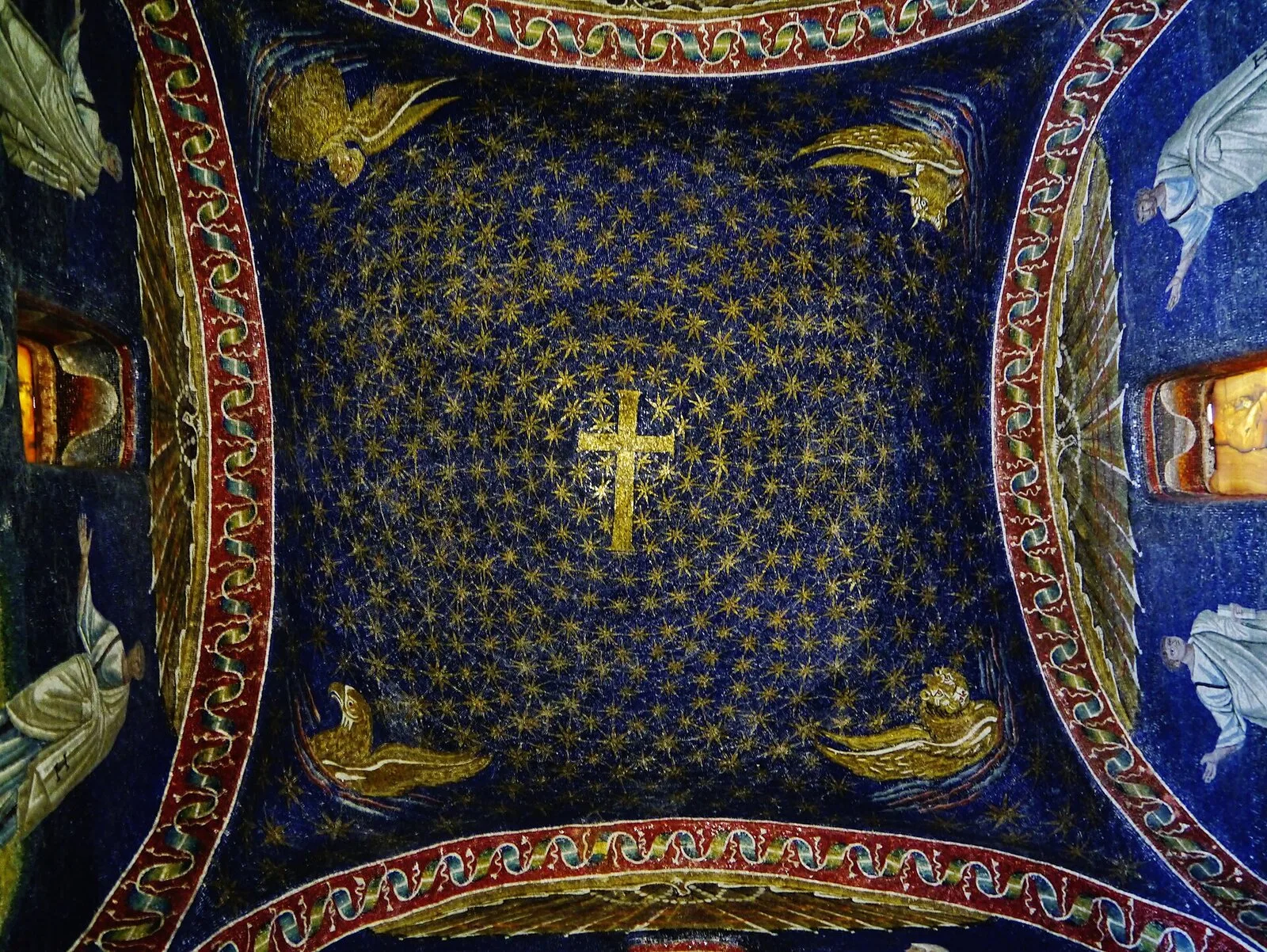
- The Mausoleum of Galla Placidia, from the mid-5th century, is a plain cross-shaped brick building on the outside; inside, the cobalt-blue dome is covered with golden stars with the cross at its centre, and the lunettes show the Good Shepherd and deer drinking from a pool. Galla Placidia, who died in 450, was probably buried in Rome.
- Sant'Apollinare Nuovo was built by Theodoric between 493 and 526 as an Arian palace church. The walls of the nave are entirely covered in mosaics, with scenes from the life of Christ and long processions of Martyrs and Virgins; the name "Nuovo" (New) dates from the 9th century, when the relics of Sant'Apollinare were brought here from Classe.
03Things to see and do
The Battistero Neoniano (Neonian Baptistery), next to the cathedral, is the best-preserved early Christian baptistery in the world: Bishop Neon (450-475) had its dome decorated, where the Baptism of Christ in the Jordan is encircled by a procession of the twelve apostles holding crowns.
The Battistero degli Ariani (Arian Baptistery), built by Theodoric at the end of the 5th century, keeps its mosaic dome showing the Baptism of a young Christ, the personified river Jordan and the apostles walking towards a jewelled throne. It came close to being turned into a warehouse and passed to the state in 1914.
The Cappella Arcivescovile di Sant'Andrea (Archiepiscopal Chapel of St Andrew), decorated in the time of Bishop Peter II (494-519), is visited inside the Museo Arcivescovile, which also holds the ivory throne of Bishop Maximian. Above the entrance a warrior Christ in armour tramples the lion and the serpent; in the vestibule the vault is filled with doves, partridges, ducks and parrots.
The Mausoleo di Teodorico (Mausoleum of Theodoric), begun around 520, is built without mortar from blocks of Aurisina stone brought by sea and is topped by a single monolithic dome 10.76 metres in diameter, estimated to weigh around 290 tonnes; the upper chamber contains a red porphyry tub.
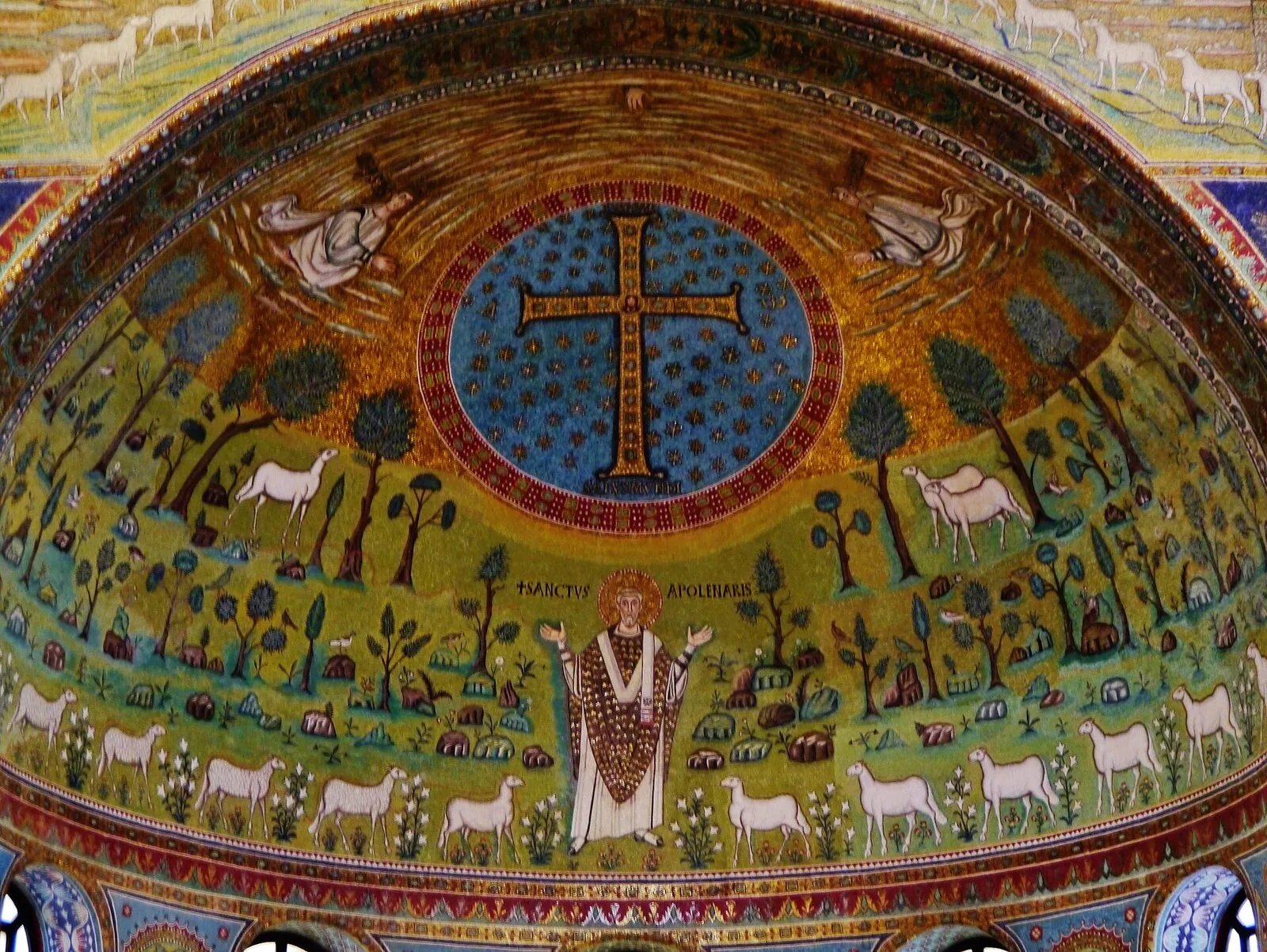
Sant'Apollinare in Classe, consecrated in 549 and recognisable by its round bell tower, stands a few kilometres from the centre on the burial site of the city's first bishop. In the apse Sant'Apollinare prays among twelve lambs in a green landscape, beneath a great jewelled cross in a sky of gold and silver stars.
Dante's Tomb, the small neoclassical temple built in 1780-1781 to a design by Camillo Morigia, holds the poet's bones, which were hidden by Franciscan friars and found by chance in 1865. The votive lamp burns oil from the Tuscan hills donated every year by Florence, and a canto of the Divine Comedy is read here every day.
Sources: turismo.ra.it · whc.unesco.org · ravennamosaici.it · museiravenna.cultura.gov.it. Information checked in October 2026.
04Visitor information
The Diocese monuments are visited with a combined ticket (2026 prices): "4 monuments" (Sant'Apollinare Nuovo, San Vitale, Mausoleo di Galla Placidia, Battistero Neoniano) €12.50; "5 monuments" (adding the Museo Arcivescovile and the Cappella di Sant'Andrea) €14.50; reduced for students and groups of more than 20 people €11.50 and €13.50; children aged 6-10 €2 and €4; free up to age 5. For Galla Placidia, the Battistero Neoniano and the Museo Arcivescovile you book an entry time; tickets are sold online up to two hours in advance or at the ticket offices of Sant'Apollinare Nuovo (Via di Roma 53) and the Museo Arcivescovile (Piazza Arcivescovado 1). Opening hours published in October 2026: until 2 November 2026 daily 9am–7pm, from 3 November 2026 to 6 March 2027 daily 10am–5pm; closed on Christmas Day and New Year's Day. The Battistero Neoniano closes to visitors from 11:30am to 12:30pm on the last Saturday of the month for baptisms. The three state monuments have their own tickets, sold online or at the Fondazione RavennAntica ticket offices: Mausoleo di Teodorico daily 8:30am–5:30pm (€6), Battistero degli Ariani Monday to Thursday 9am–12pm and Friday to Sunday and public holidays 9am–12pm and 2pm–5pm (€3), Sant'Apollinare in Classe Monday to Saturday 8:30am–7:30pm and Sundays and public holidays 1:30pm–7:30pm (€6); combined ticket with the Museo Nazionale and the Palazzo di Teodorico €14. They are free on the first Sunday of the month and on 4 November. Dante's Tomb is free to enter: 10am–7pm from 1 April to 31 October, 10am–6pm from 1 November to 31 March. The centre has ZTL restricted-traffic zones with cameras: free car parks include Antico Lazzaretto (224 spaces) and Piazzale Natalina Vacchi (248), as well as the Pala De André and Cinema City park-and-ride car parks served by buses. Sant'Apollinare in Classe can be reached on bus no. 4 from Ravenna railway station, by train to Classe station or by bike, and has a large car park.
Opening hours, prices and dates may change: always check the official website before you go.
Sources: ravennamosaici.it · turismo.ra.it. Information checked in October 2026.
05How to get there from Hotel Viking
By car: 47.7 km, about 70 minutes. At reception we can suggest the best route and the most convenient car parks; your space at the hotel stays reserved in our private car park, which is fenced and covered by CCTV.
Without a car: bus no. 4 stops 100 metres from the hotel (stop 25) and runs to Rimini railway station, where regional trains leave for Ravenna station.
06Nearby
- Basilica of Sant'Apollinare in Classe and the Museo Classis (Classe, about 5 km from the centre)
- Pineta di Classe, the pine forest Dante praised as the "divina foresta spessa e viva" (divine forest, dense and alive)
- Mirabilandia (about 10 km)
- Safari Ravenna
- Ravenna's beaches: Marina di Ravenna, Punta Marina, Lido di Savio
- Cervia, Milano Marittima and the salt pans (about 20 km)
- Cesenatico and Milano Marittima
- Mirabilandia
- Safari Ravenna
More ideas for days out from the hotel on things to do in Rimini and on the hinterland and hilltop villages page.
07What our guests say
What guests say about the hotel's location and day trips.
Day trips
«You can book trips inland with the help of the reception staff»
Handy for everything
«excellent location, close to everything, the sea included, but on a quiet street.»
08FAQ
How much is the combined ticket for the Ravenna mosaics?
In 2026 the "4 monuments" combined ticket (Sant'Apollinare Nuovo, San Vitale, Galla Placidia and the Battistero Neoniano) costs €12.50; adding the Museo Arcivescovile and the Cappella di Sant'Andrea ("5 monuments") it costs €14.50. The Battistero degli Ariani, the Mausoleo di Teodorico and Sant'Apollinare in Classe are state-run and have separate tickets (combined ticket €14 with the Museo Nazionale and the Palazzo di Teodorico).
Do you need to book to see the Mausoleum of Galla Placidia?
Yes: for the Mausoleo di Galla Placidia and the Battistero Neoniano (and for the Museo Arcivescovile with the 5-monument ticket) you have to choose an entry time. Online booking is free and possible up to two hours in advance; on busy days visits to these small monuments are limited to 5 minutes.
Do you have to pay to see Dante's Tomb?
No, Dante's Tomb at Via Dante Alighieri 9 is free to enter every day (10am–7pm from April to October, 10am–6pm from November to March; closed on 25 December).
How far is Ravenna from Hotel Viking?
47.7 km, about 70 minutes by car from Viserbella di Rimini; without a car, take the bus to Rimini railway station and then the train.
How long do you need to visit Ravenna?
A full day: the monuments in the centre can be seen on foot in 4–5 hours, while Sant’Apollinare in Classe is outside the city.
Where to stay to explore the Romagna Riviera?
At Hotel Viking in Viserbella di Rimini: a 3-star hotel 100 metres from the sea, with a private car park, open all year round, halfway between Ravenna and Gabicce.


